Are Job Transfers Involving Relocation Truly Negative? How Murata Manufacturing Uncovered the Reality of Relocation Through 7 Years of HR Data

Are Job Transfers Involving Relocation Truly Negative? How Murata Manufacturing Uncovered the Reality of Relocation Through 7 Years of HR Data
- Verified Themes: Do employees feel reluctance regarding transfers that involve relocation? Does relocation affect their subsequent careers and work styles?
- Data Utilized: Employee profiles, payroll, attendance, and evaluation data from the core HR system, combined with official transfer order records.
- Findings: Across four key metrics—turnover, performance evaluation improvement, base salary growth, and medical leave—no evidence was found indicating that transfers involving relocation led to negative outcomes.
- Next Steps: Shifting from “worrying uniformly about everyone” to “pinpointing who to monitor using data.” Murata Manufacturing identified future points of inquiry and the specific data required to test them.
Panalyt Inc., provider of the People AI Analyst “Panalyt,” collaborated with Murata Manufacturing Co., Ltd. on an “HR Data Analysis Project Regarding Relocation and Job Transfers,” delivering the final report in October 2026. This project examined and tested the long-held internal anxieties regarding relocation one by one against seven years of HR data.
Executive Summary
Murata Manufacturing already had an HR dashboard in place, providing an environment to “observe” their talent metrics. On the other hand, there were various opinions within the company regarding transfers that involve relocation, but there had been no means to objectively verify whether an aversion truly existed or if the outcomes for relocated employees worsened afterward. Factual verification was required to make balanced decisions between maintaining talent mobility to support business operations and caring for employee well-being.
Panalyt connected core HR system data with transfer order records, breaking down the overarching theme into testable questions to analyze seven years of historical data. After controlling for differences in fiscal year, job track, age group, and pre-transfer evaluation, no evidence was found that transfers involving relocation led to adverse outcomes across four key metrics: turnover, performance evaluation improvement, base salary growth, and medical leave. The analysis simultaneously provided objective justification to continue their current relocation practices while identifying specific conditions that warrant extra care.
At the conclusion of the analysis, Panalyt clearly distinguished between what current data can and cannot prove, organizing the next set of questions to verify and the exact data points required. Moving forward, Murata Manufacturing will expand its investigations into questions such as how relocation experiences impact skill enhancement and accelerated talent development, as well as combining analyses with engagement surveys to identify individuals who may need proactive support.
Starting from “We Feel the Problem, but Cannot Verify It”
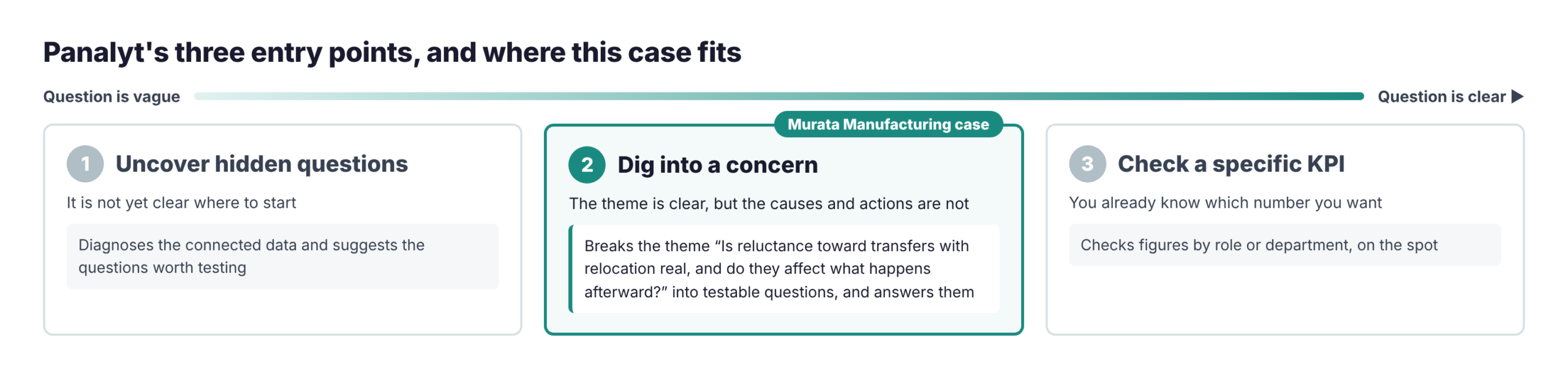
Panalyt provides three points of entry tailored to client situations: uncovering core questions when the organization is unsure what to ask; deep-diving into issues when themes exist but root causes and solutions are unclear; and tracking trends when specific target metrics are already determined.
This initiative with Murata Manufacturing corresponded to the second entry point: “deep-diving into issues.” The hypothesis—that employees might feel reluctance toward transfers involving relocation—was clear. What was missing was how to formulate verifiable questions and how to prepare the data to test them.
Questions That Could Not Be Answered by “Visualizing” Alone
Murata Manufacturing built an internal HR dashboard starting in 2025, establishing an environment where diverse talent-related information could be monitored.
However, the internal questions raised regarding transfers could not be answered with dashboard figures alone. While counts of transferred employees and snapshot breakdowns by attribute can be viewed, answering questions like “What happened to employees after their transfers?” or “Did relocation affect retention or career progression?” requires tracking individuals chronologically before and after their transfer and comparing them with appropriately matched peer groups.
“We were limited to viewing snapshots, and we were not yet able to track and analyze data as an ongoing ‘flow.'” (Mr. Masato Watanabe)
Breaking Down “Does Aversion Truly Exist?” into Verifiable Questions
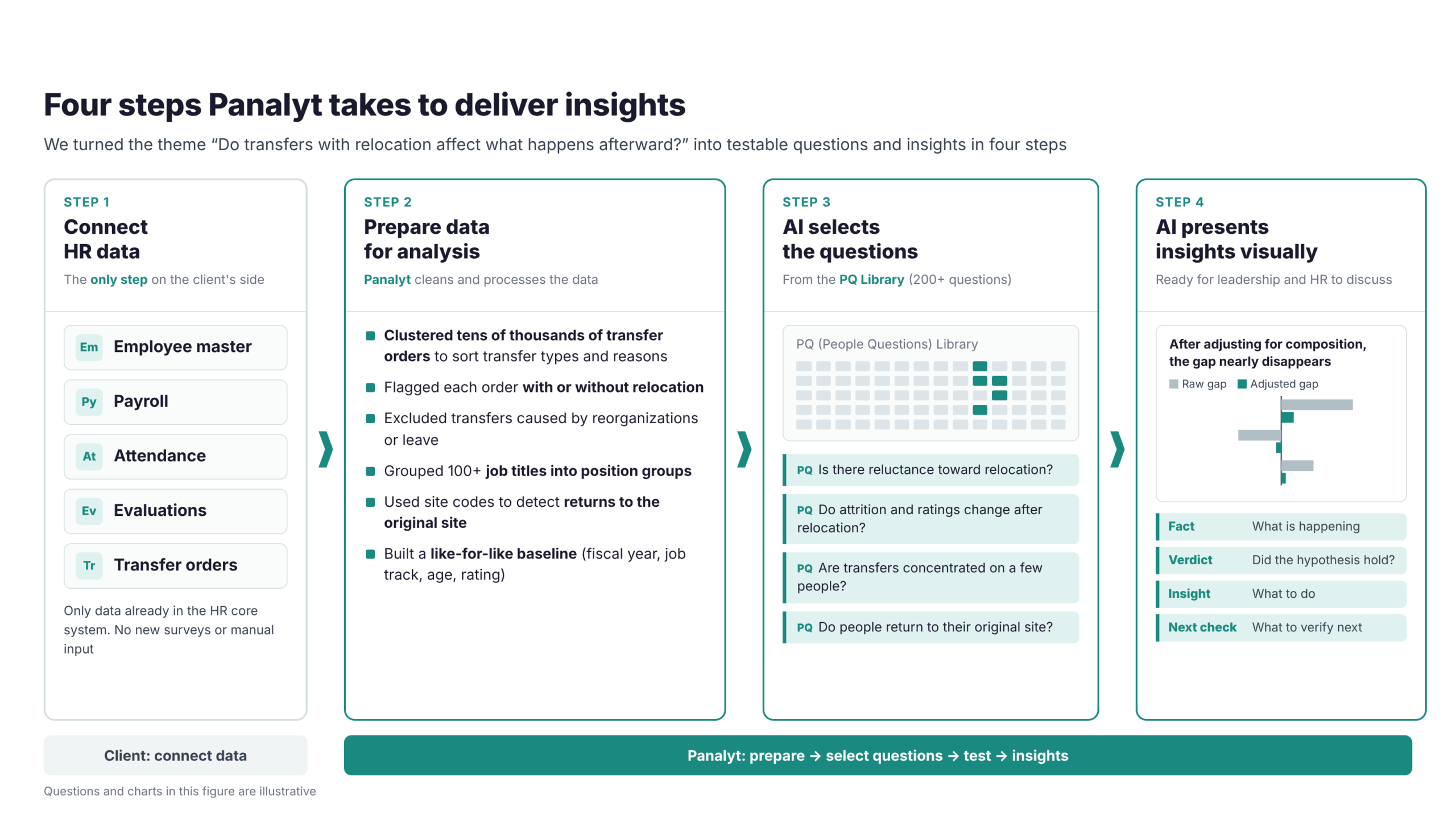
“Aversion to relocation” is not explicitly recorded anywhere in HR databases. Therefore, rather than attempting to analyze the broad concept directly, Panalyt began by breaking it down into specific questions that could be answered with data. Panalyt refers to these as People Questions (PQs), drawing from an internal library of over 200 common organizational HR questions.
In this project, Panalyt conducted comprehensive interviews regarding Murata Manufacturing’s concerns and translated them into questions such as:
- Does aversion to relocation-involved transfers actually exist? If so, among whom and in what manner does it manifest?
- Following a transfer involving relocation, do turnover rates, performance evaluations, or compensation deteriorate?
- Are transfers disproportionately concentrated among a specific group of employees?
- After an assignment involving relocation, are employees able to return to their original locations?
Factors that cannot be measured directly, such as aversion, are assessed through “signals” reflected in actual employee behavior—such as trends in voluntary transfer requests or changes in the proportion of transfers requiring relocation. The findings supported some internal perceptions while contradicting other long-standing assumptions.
Connecting Existing Core HR Data Without Requiring New Surveys
This analysis relied entirely on existing employee profile, compensation, attendance, and evaluation records within the core HR system, combined with official transfer order records. No new employee surveys were conducted, and no additional data entry was required from frontline staff.
However, core system data cannot be used for advanced analysis without preparation. Panalyt handled the entire data cleansing pipeline to transform connected records into an analysis-ready format:
- Clustering text data across tens of thousands of transfer orders to standardize transfer types and rationale.
- Determining whether each individual transfer order required physical relocation.
- Excluding non-individual moves, such as organizational restructuring or medical leave transfers.
- Consolidating over 100 internal job titles into standardized job groups suitable for analytical comparison.
- Tracking facility and office codes to determine whether employees returned to their original base locations.
- Controlling for fiscal year, job track, age group, and pre-transfer evaluations to establish a fair baseline comparing what would have normally occurred for employees under identical conditions.
AI then selected the most relevant questions from the PQ library against this cleansed dataset, consolidating analytical findings into visual insights and actionable recommendations. The seamless execution from data preparation to question selection, validation, and insight generation is a hallmark of the People AI Analyst “Panalyt.”
Findings: No Evidence Found That “Transfers Involving Relocation Lead to Worse Outcomes”
Directly comparing employees who experienced relocation with those who did not can lead to flawed conclusions. This is because the age distribution, job categories, and pre-transfer performance ratings of relocated employees inherently differ from those who remain in place.
To address this, Panalyt standardized and compared groups while controlling for differences in fiscal year, job track, age bracket, and pre-transfer evaluation. As a result, across all four key metrics—turnover, evaluation improvements, base salary growth, and medical leave—no evidence emerged showing that outcomes worsened following a transfer involving relocation. Most observed differences were fully attributable to demographic and role-based baseline distributions.
This does not mean that “relocation is something organizations can completely ignore.” Rather, the value of this analysis lies in using empirical data to clearly distinguish what legitimately requires care and what has been unnecessarily over-worried.
From Uniform Consideration to Data-Driven Targeted Care
Rather than suggesting that transfers should simply be reduced, the findings revealed the next critical question: “Under which specific circumstances should organizations exercise greater care?” For instance, individuals who experienced multiple relocations within a short period surfaced as a cohort requiring deeper assessment.
A key principle was not jumping to hasty conclusions based solely on the current analytical scope. Where relevant, the report outlined “what additional data points should be examined next to make firmer decisions.” For example, determining whether employees who have not returned to their original bases are doing so by personal choice or due to a lack of openings requires information regarding individual preferred work locations.
Moving beyond merely confirming “what is happening” to deriving “what to verify next” directly from data deepens organizational understanding and firmly anchors people analytics across corporate decision-making.
Reports Ready for Immediate Executive and HR Discussions
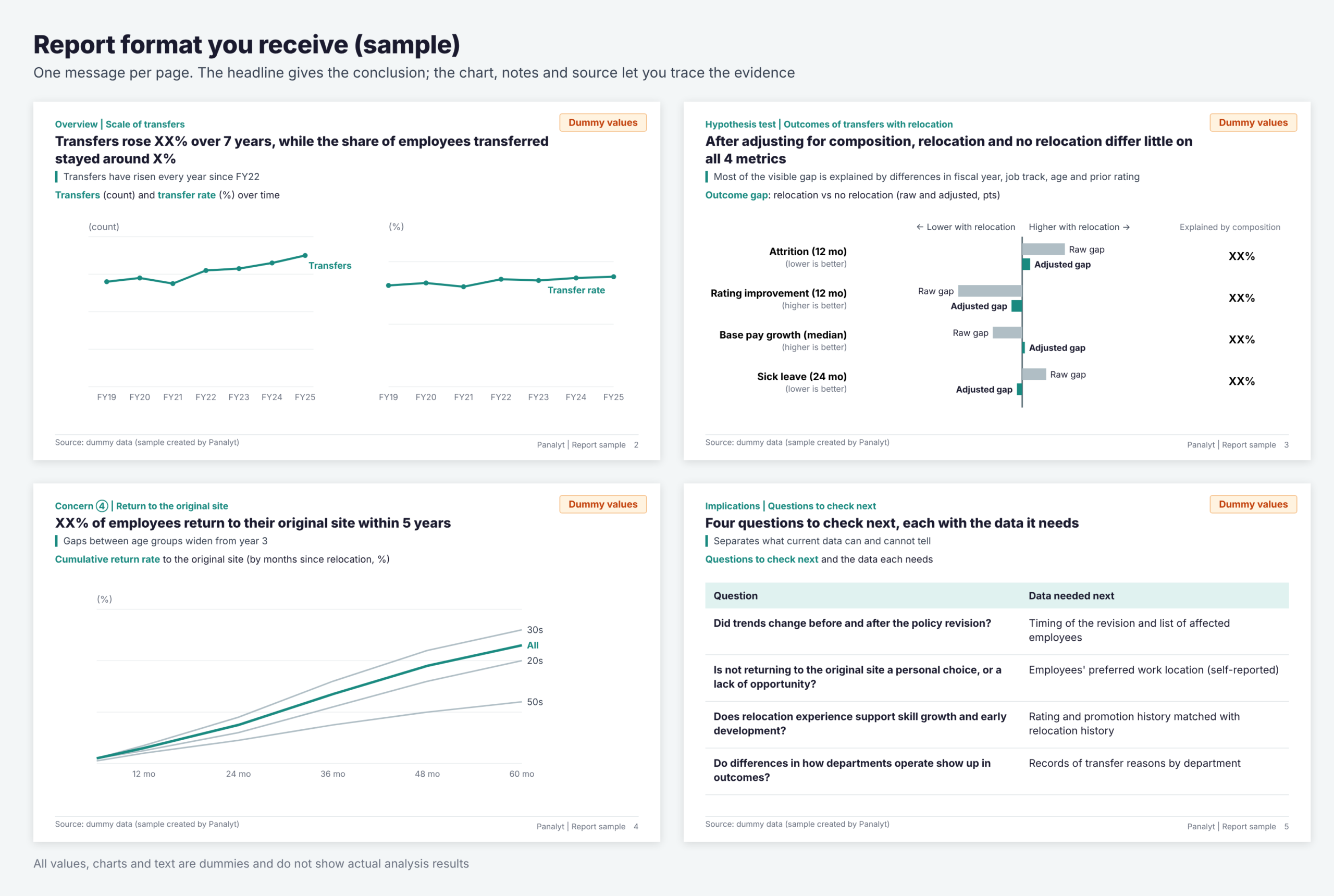
Panalyt’s final deliverables adhere to a “one message per slide” executive format. Stakeholders can understand conclusions immediately from headings, while supporting evidence can be confirmed through charts, annotations, and clear data sources. Progressing from an overarching overview to hypothesis testing by issue, followed by actionable insights and future verification points, the report is structured for immediate use in executive and HR meetings.
Another defining feature is the clear categorization of findings into “Confirmed Facts,” “Contradicted Hypotheses,” and “Inconclusive with Current Data.” This structure ensures analytical findings translate seamlessly into subsequent decisions and concrete actions.
Addressing Employee Concerns Grounded in Objective Facts (Data)
Regarding transfers involving relocation, HR departments frequently encounter employee concerns such as, “If I relocate, will I never be able to return to my original location?” or “Will this transfer increase my personal burden?”
When responding to these concerns, dialogue shifts significantly if HR can present factual findings derived from actual data, rather than merely explaining policy intent or HR philosophy. In this project, analyzing the duration and proportion of employees returning to their original base locations by age cohort enabled HR to address vague anxieties by clearly communicating what has been empirically confirmed versus what requires continuous monitoring.
With data in hand, HR can move beyond defending policies to addressing employee concerns through shared factual realities. The evidence obtained serves as valuable decision-making criteria for shaping future mobility strategies while facilitating constructive communication that fosters mutual trust with employees.
Future Outlook: Deepening Questions Toward Next Decisions
Building upon the future inquiry points outlined in this analysis, Murata Manufacturing is well-positioned to expand into further hypothesis testing: Does relocation experience contribute to competency development and accelerated leadership growth? Can combining these findings with employee engagement surveys help identify individuals needing proactive attention earlier? As one question is answered, the next meaningful inquiry naturally emerges.
What Panalyt delivers extends beyond simple data analysis and reporting. It transforms HR challenges into scientifically verifiable questions and converts evidence and insights into tangible strategic decisions. This embodies Panalyt’s core model of “Insight as a Service”—delivering seamless value from data integration to high-level organizational insights.
To HR Leaders Facing Similar Challenges
If you are looking to “verify HR challenges and their organizational impacts using objective data,” or “feel an organizational issue but do not know where to start analyzing,” please feel free to reach out to us. We will partner with you every step of the way—from connecting your existing HR data to question design, empirical verification, and strategic insights.
Senior Manager, HR IT Promotion Section, Human Resources Department, Human Resources Division, Administration Unit
Murata Manufacturing Co., Ltd.
While we were already capable of reviewing organizational metrics on our internal HR dashboard, our perspective was limited to viewing static snapshots. For key dynamics such as personnel transfers or promotion velocity, we were not yet able to capture and analyze the data as an ongoing “flow.” In this engagement, being able to analyze data based on our specific problem awareness and receive actionable insights from it has been exceptionally reassuring.
Amid various differing opinions within the company regarding personnel transfers, this analysis allowed us to verify the actual situation through objective data. We feel this provided highly valuable insights for designing our future transfer strategies. Furthermore, having empirical evidence will be broadly beneficial not only for executive decision-making, but also for explaining the context and rationale behind our policies to our employees.
Within our organization, understanding and maturity regarding the significance and practical application of people analytics still vary across departments. Within that context, having the opportunity to review and discuss actual data through this initiative served as an important catalyst to shift internal awareness and our overall approach toward data.
Through this project, I strongly feel that we will be able to pursue further exciting initiatives together with Mr. Ogawa, Mr. Tran, and the entire Panalyt team. We look forward to continuing discussions regarding diverse possibilities going forward.